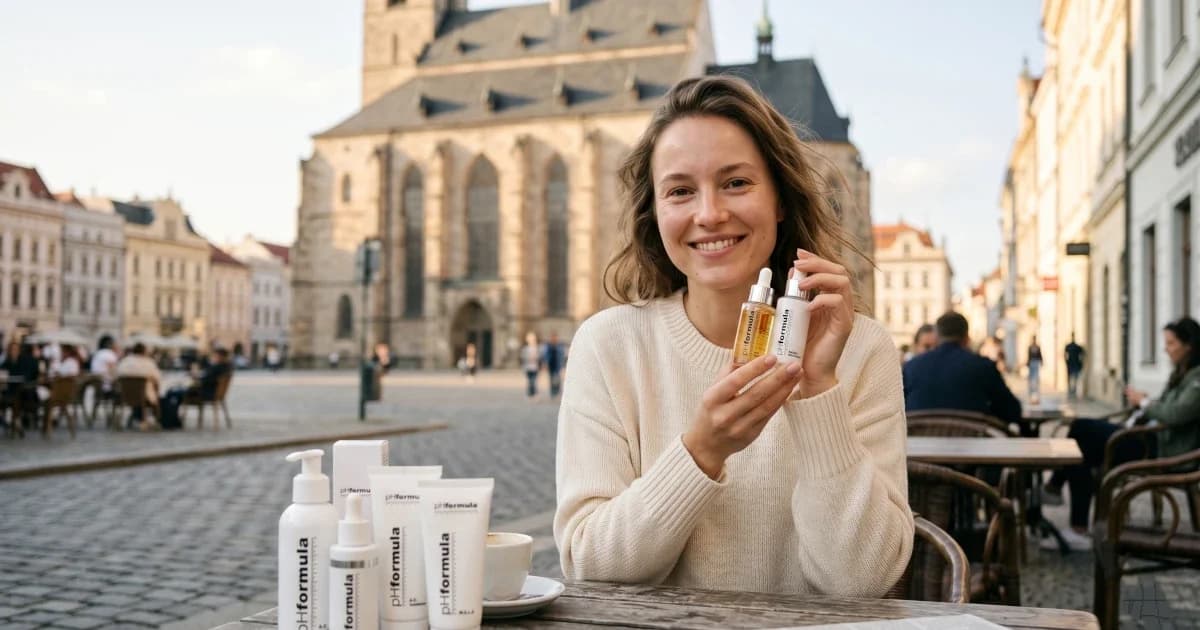
The average woman spends twelve minutes a day choosing her coffee and roughly four seconds deciding whether to apply that £80 serum or skip it again. The second decision is, obviously, the more important one. And paradoxically, the faster.
Skin is not a coffee machine. You can't keep tossing in different beans and expecting it to produce a perfect espresso each morning. It's a system. And when something in the system goes off — pigment, pores, texture, that glow which isn't a glow anymore but the tired reflection of a monitor — spot-treatments stop being enough. Pigment cream lightens the spots a little. Anti-wrinkle serum addresses the two wrinkles you stare at while brushing your teeth. Pore toner shrinks pores by approximately two micrometers, which you can't actually see, but you trust it, because it cost £45.
Skin doesn't need another bottle. It needs a reboot. Which is precisely where the pHformula chemical peel walks in.
The Illusion of Five Serums and One Miracle
A particular kind of archaeology is happening in bathrooms across Pilsen — and probably across most of Europe. On the top shelf, day cream. Below it, night cream. Below the night cream, a retinol bought in January and used "every other day", which in practice means "when I remember, so monthly". Beside that lurks the vitamin C nobody quite knows how to integrate, because one blog post said it can't be mixed with niacinamide, and you're not entirely certain what niacinamide is, but you bought that too, just to be safe.
Three toners on the shelf. Two peels. One enzymatic powder you opened twice and forgot about. Seven serums. A mask that requires fifteen minutes of stillness, which you've never quite managed past ten. And yet: the pigment spot on your cheekbone is exactly where it was last year. Your skin is slightly more tired. Pores haven't shrunk — they've simply added new colleagues.
This condition has a name: skincare paralysis. It's when you own so many products your skin has stopped trusting you. And rightfully so. Because each of those products attacks one symptom — pigment, wrinkles, oiliness, dryness — but none of them speak to each other, and together they still don't address the actual issue: skin needs renewal, not more information.
Renewal isn't about shopping. It's about process. About the moment your skin cells are persuaded to do something they've stopped doing voluntarily. And no amount of artisanal essence-oils sourced from a Korean monk's volcanic spring is going to convince them. They want a system. Or, occasionally, a wake-up call.
What pHformula Is and Why It Sounds Like a Chemistry Exam
The name pHformula sounds like something you should have memorized for your A-levels rather than something to apply to your face. But behind the slightly clinical label sits one of the more interesting skincare philosophies of the last decade. It's called resurfacing — controlled, gradual, safe renewal of the skin's surface.
A traditional chemical peel removes the upper layer of skin. It works, often spectacularly, but it tends to come with side dishes: redness, peeling, five days during which you don't leave the house without sunglasses indoors. This system approaches things differently. Instead of stripping the skin away, it asks the skin — politely but firmly — to renew itself. Through the patented PH-DVC™ delivery system (Direct Vehicle Carrier — yes, it really does sound like a Tube line, and frankly, that's not far off the truth), active ingredients reach exactly where they should, in the right concentration, without the aggressive "burn" of conventional peels.
The result: skin works, you don't cry. This isn't a peel that takes you out of social rotation for a week. This is the peel after which you can have coffee the next day, and your colleague will assume you finally got eight hours' sleep. (You didn't. Your skin is just reflecting light the way it did in your twenties.)
What does it actually address? Sun-induced hyperpigmentation, post-acne marks, enlarged pores, loss of elasticity, fine lines, uneven tone. Not all at once — but yes, all within one course of treatment. Because skin is a system. And when you renew it systemically, results don't add up. They multiply.
What Actually Happens in the Treatment Room
The procedure itself has something unexpectedly calm about it. No drama. No internal voice whispering "this is a big step, darling". You're simply lying there, warm, while someone works above you slowly and with focus, and you wonder whether you turned off the iron.
Cosmetologist Viktoria first looks at your skin properly. Not in the Instagram way — "what's your skin type, dry, oily, combination?" — but with actual attention. Where the pigment is deep versus superficial. Where pores are an aesthetic concern versus a functional one. Where skin is just tired versus genuinely dehydrated. Based on this, she selects a specific formulation — because the system has several lines, ranging from gentler resurfacing to more intensive work on pigment or post-acne marks.
The application itself takes roughly an hour. You'll feel mild warmth, occasionally a slight tingle — not burning, not discomfort, just the polite signal that the product is working. No frosting. No shock. No moment of "is this actually a good idea?".
After the treatment, you'll receive home care that's part of the system — because resurfacing doesn't work as a one-off intervention but as a course. The standard protocol involves three to four treatments spaced several weeks apart, supported by daily home maintenance. After a month, you see it. After two, others see it.
This is what separates resurfacing from a regular peel: you're not waiting for a miracle after one visit. You're building one. Layer by layer — except this time, in reverse, from the surface inward.
Frequently Asked Questions
Will it be obvious at work that I had a treatment? The short answer: not in the way you're imagining. The longer answer: the system is specifically formulated to avoid the visible peeling and redness that would force you into hiding. Post-treatment, your skin may be slightly pink for a few hours, the way it looks after exercise or after delivering an uncomfortable truth to someone. The next day, you go to work. By day three, a colleague will start suspecting you spent the weekend somewhere with palm trees. Unlike traditional aggressive peels, this one doesn't operate on the philosophy of "let's destroy the surface and see what grows back". It operates on "let's encourage the cells to do their job faster". Side effects are gentler. The main effect, paradoxically, is more striking.
Does it actually work on pigmentation? Yes, though the honest answer is: gradually. Pigmentation isn't a stain someone painted on. It's the result of melanocyte activity — pigment-producing cells that, for various reasons (sun, hormones, the dual-headed monster of both), have decided to work with unwarranted enthusiasm. Resurfacing doesn't silence these cells in one session. It gradually regulates their activity, accelerates the turnover of pigmented cells, and simultaneously evens out the overall tone. After the first treatment, you'll notice brightening. After the third, others will notice the difference. After the fifth, someone will guess your age and miss — but, this time, in your favour.
Can I do this in the summer? You can, but it's a bit like eating ice cream in November — possible, but the obvious question is "why now?". The ideal window is autumn and winter, when UV activity is lower and skin has calmer conditions for renewal. Summer treatments are planned more carefully and always with religious adherence to SPF 50, which you should be wearing year-round anyway — yes, we know you're not. Pilsen summers are short, but they're long enough to undo the work you did in winter if you skip the sunscreen.
How many sessions do I need and how often? The standard course is three to five treatments at three- to four-week intervals. It sounds like a commitment, and it is — but no more so than your gym membership, which you use enthusiastically every January and again in vague spurts during October. The difference is that here, you actually see the result. After the initial course comes maintenance — one treatment every few months — because skin that feels good wants to stay feeling good. And that's a reasonable expectation.
In Closing
Skin isn't a project you finish. It's a relationship you maintain. And, like every long relationship, it deserves the occasional grand gesture — not the gold earrings on your anniversary, but a genuine moment when you say: yes, I see you, I hear you, I'll give you what you actually need.
pHformula in Pilsen isn't a miracle. It's a system. And systems work when you trust them long enough to let them prove the point. At Viktoria's clinic, the consultation happens at a calm pace — no pressure, no "you need this immediately", no thirty-page treatment catalogue presented like a wine list. Just a conversation about what your skin actually needs, and what it doesn't.