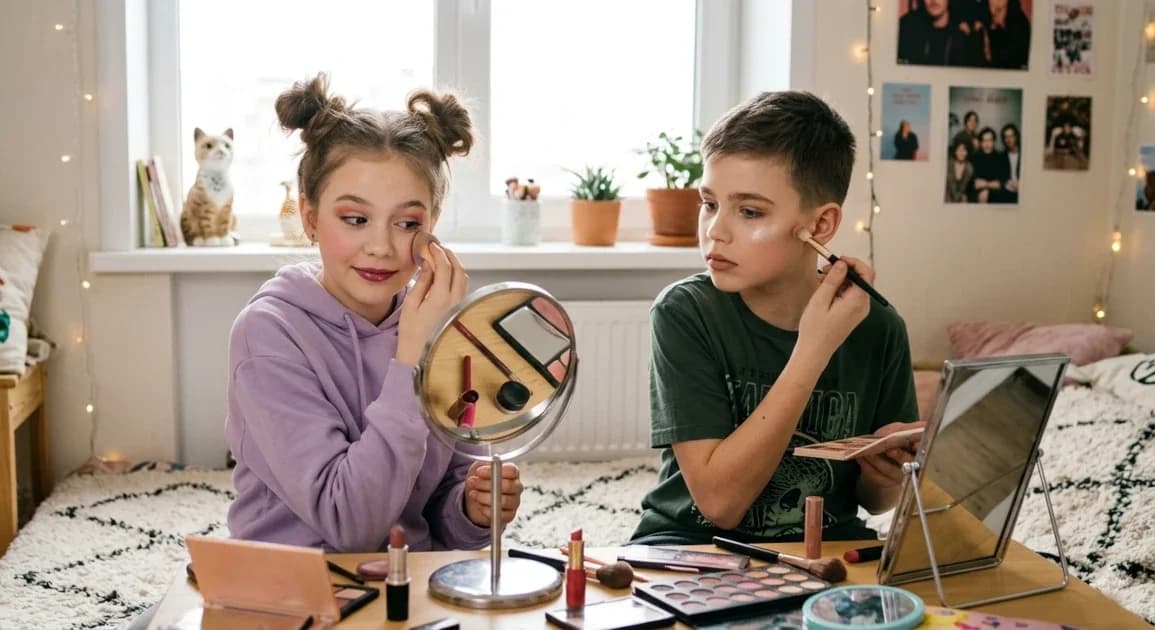
Somewhere between the invention of TikTok and last Tuesday, a quiet revolution happened in bathrooms around the world. Ten-year-olds started asking for hyaluronic acid for their birthdays. Twelve-year-olds began building skincare routines with the precision and seriousness of a NASA launch sequence. And fourteen-year-olds started debating the merits of retinol versus bakuchiol with the kind of passion most adults reserve for parking disputes.
The phenomenon has a name — "Sephora Kids" — and it's not a niche internet joke. It's a global shift in how the youngest generation thinks about young skin care. Children are walking into beauty shops with specific ingredient lists, brand preferences, and a vocabulary that would impress a dermatologist. What they don't have, unfortunately, is any real understanding of what their skin actually needs.
It's a bit like watching someone install a turbocharger on a bicycle. Impressive commitment, questionable logic.
Let's talk about what's really going on, what young skin genuinely requires, and when it might be worth consulting someone who spent years studying this rather than scrolling through it.
The Great Skincare Overcorrection: Why More Steps Don't Mean Better Skin
Picture this: a twelve-year-old girl's morning routine. Micellar water. Acid toner. Vitamin C serum. Moisturiser with peptides. SPF. That's five products before breakfast, and she hasn't even started on her homework from last night.
The teen skincare routine has become a cultural phenomenon. Brands have noticed, naturally, because brands notice anything that involves people spending money. The result? An avalanche of "youth-targeted" products that contain the same aggressive active ingredients as their adult counterparts, just in prettier packaging. Think of it as putting a spoiler on a tricycle.
Here's what the marketing conveniently doesn't mention: young skin is spectacularly good at looking after itself. Before roughly the age of twenty-five, your skin cell turnover is already operating at peak efficiency. Collagen production is humming along nicely. The lipid barrier is intact and functioning. Pouring AHAs, BHAs, and retinoids onto this perfectly functional system isn't skincare — it's interference.
And interference has consequences. Disrupted skin barriers, increased sensitivity, dehydration masquerading as oiliness, and a confused complexion that now actually does need help — precisely because someone tried to help it too much. The irony is almost poetic.
What Young Skin Actually Needs (Spoiler: It's Boring)
Effective young skin care is magnificently dull. It has no place on TikTok because there's nothing to film. Three products. Two minutes. Zero drama.
Step one: gentle skin cleansing. A mild gel or foam that removes excess oil and daily grime without stripping the skin barrier. If your face feels "squeaky clean" afterwards, you've gone too far. That squeak is the sound of your lipid barrier waving goodbye.
Step two: lightweight moisturiser. Even for oily skin — especially for oily skin. Dehydrated oily skin overcompensates by producing more sebum, which leads to spots, which leads to harsher products, which leads to more dehydration. It's a doom spiral with excellent packaging.
Step three: sunscreen. SPF 30 or higher, every single day. This is the one genuinely effective anti-ageing product, and it works at any age. If you're going to invest in one thing, make it this.
That's the entire routine. It costs roughly the same as a coffee, takes less time than finding a matching pair of socks, and does more for young skin than any twelve-step regimen currently going viral.
But what about acne? What about breakouts? What about the spots that appear with all the timing and subtlety of a fire alarm at 3 a.m.? Ah. Now we're entering territory where internet advice stops being merely useless and starts being actively counterproductive.
When It's Time to See an Actual Professional
Here's a radical thought: the first visit to an aesthetician doesn't have to be prompted by a crisis. In fact, it's considerably more useful when it isn't.
A qualified aesthetician — and I mean properly trained, not someone who did a weekend course and bought a ring light — can do something that no app, influencer, or well-meaning friend can manage. They can look at your specific skin, in person, and tell you what it actually needs. Not what's trending. Not what has a nice bottle. What your particular face, with its particular concerns, in its particular state, requires right now.
For teenagers, this usually means a consultation and perhaps gentle cleansing. No dramatic procedures, no needles, no acids. Just an expert assessment of whether the skincare routine assembled from various social media sources is helping, harming, or simply wasting money.
In Plzeň, Viktoria offers exactly this kind of consultation — and parents who bring their teenagers in tend to leave with the same slightly surprised expression. Surprised because the advice is usually to use less, not more. It's possibly the only corner of the beauty industry where the professional recommendation is to put your wallet away.
Frequently Asked Questions
At what age should a teenager see an aesthetician?
There's no universal answer, but somewhere around twelve to fourteen — when hormonal changes start affecting the skin — is a sensible starting point. Or earlier, if your child has already assembled a skincare collection that rivals a department store counter. A consultation isn't a procedure; it's a conversation. And that conversation can prevent months of trial, error, and unnecessarily irritated skin. Think of it as directions before a road trip rather than repairs after a breakdown.
Is retinol actually harmful for young skin?
"Harmful" is perhaps too strong; "pointless" is more accurate. Retinol accelerates cell turnover and boosts collagen production — both things young skin already does brilliantly on its own. Using retinol at thirteen is like hiring a personal trainer for someone who naturally runs marathons for fun. Unnecessary at best, counterproductive at worst. It can thin already thin skin, increase sun sensitivity, and create problems where none existed. If a teenager wants something active, low-concentration niacinamide is a far more sensible option — but even that should ideally come recommended by a professional.
How do I talk to my teenager about their excessive skincare?
Don't dismiss the interest — redirect it. Saying "you don't need all that" to a teenager is approximately as effective as telling the tide not to come in. Instead, try: "Let's find out what a professional thinks." A joint visit to an aesthetician transforms the conversation from parent-versus-teen into a collaborative investigation. It validates their interest in self-care while introducing the revolutionary concept of expert guidance.
How much should a teen skincare routine cost?
A gentle cleanser, a basic moisturiser, and sunscreen. That's the foundation, and it costs less than most of the individual serums being marketed at young people. Everything beyond this should be recommended by a professional for a specific concern. The most valuable thing you can buy for a teenager's skin isn't a product — it's a consultation. Because good advice tells you what not to buy, and that's where the real savings begin.
Generation Alpha will care about their skin — that ship has sailed, and frankly, it's not a bad thing. The question is whether that care will be guided by algorithms or by expertise. And the answer, thankfully, doesn't require a twelve-step routine. It requires a single step: walking into a professional's office and saying, "We're not sure where to start." Viktoria in Plzeň, for instance, has heard that sentence before. It's her favourite one.